Pulztrones: SLRC 2025 autonomous robot
A two-processor robot for the Sri Lanka Robotics Challenge: a Raspberry Pi for vision, an STM32 for motion and the arm, and a framed UART link between them. 1st runner-up in the university category.
- Role
- Team lead, Pulztrones
- Period
- 2025
- Stack
- STM32F446RE · Raspberry Pi 4B · Embedded C · Python · OpenCV · SolidWorks
- Links
- Repository
- robotics
- embedded
- computer-vision
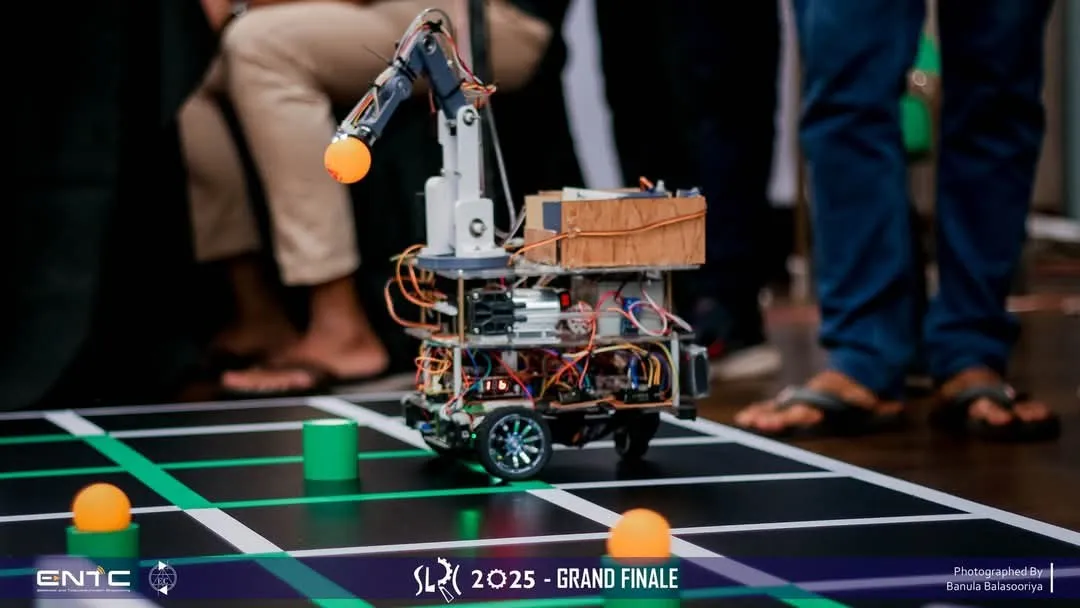
The Sri Lanka Robotics Challenge runs its university category as a single arena with a chain of tasks: a plantation grid, a muddy road, a ramp, a QR code to read, a collection point, potatoes to sort, two warehouses, an outdoor section, and a hidden task revealed only on the day. A robot has to get through all of it without a driver. Ours placed 1st runner-up.
Two processors, one serial link
A Raspberry Pi 4B handles perception, where the work is image processing and nothing is real-time. An STM32F446RE handles motion, where a late control loop means a robot in the wall. Neither is much good at the other’s job.
They talk over UART with framed packets: a start marker, a command byte, the payload, an end marker. Line detections, grid positions and colour readings go one way; the firmware sends back encoder counts, IR values and time-of-flight distances, which made the link double as a debug channel during tuning.
Motion
Everything runs on a 50 Hz tick. Driving splits into a forward axis and a rotational one, each with its own PID error term and each fed by a trapezoidal profile: a state machine over accelerating, braking and finished that integrates speed and position every tick. Asking for a 300 mm move or a 90 degree turn becomes a profile the controller tracks, rather than a distance the robot approaches and overshoots.
The gains are not hand-tuned. Both axes were identified as first-order systems, each measured for a DC gain and a time constant:
| Axis | Km | Tm |
|---|---|---|
| Forward | 977.54 mm/s per volt | 0.257 s |
| Rotation | 595.55 deg/s per volt | 0.166 s |
The gains then fall out of the model, at a damping ratio of 0.707 and with the derivative time set equal to the time constant:
Kp = 16·Tm / (Km·ζ²·Td²) and Kd = f·(8·Tm − Td) / (Km·Td)
Feedforward comes from the same two numbers: 1/Km holds a steady speed,
Tm/Km covers acceleration, and a measured 0.18 V bias gets the motors off
their stiction. It can be switched off independently of the PID, which is how
you find out which half is misbehaving. Retuning after a mechanical change
means re-measuring Km and Tm rather than twiddling four numbers by feel.
Odometry is 0.0616 mm per encoder count, with heading taken from the wheel difference across a 93.5 mm half-track. Line following runs at 85 mm/s under 120 mm/s² of acceleration; spin turns at 150 deg/s under 50 deg/s²; the plantation grid is 153 mm cell to cell.
Steering is a separate PD loop layered on top, clamped to 0.6 deg/s of correction so one bad range reading cannot swing the robot off line. It holds a left wall, a right wall, a front wall, a line, or a grid centre, and the task code switches mode as the arena changes under it. Walls register above a threshold of 80 counts to the side and 75 ahead, against nominal standoffs of 90 mm and 80 mm.
The arm
A four-servo arm on a PCA9685 picks balls and places them. Each move interpolates in one degree steps at 15 ms intervals rather than sending the servo straight to its target, which keeps the chassis from rocking when the arm swings out over the edge of the wheelbase.
The end effector is a vacuum gripper rather than a claw, which is the easier mechanism for a sphere: no alignment, no grip force to get right. An onboard colour sensor reads the ball at the pickup pose, the pump runs for two seconds to lift it, and the arm drops it into one of two bins by that reading, each released by its own servo gate.
The arm, its mounts and the storage gearing were modelled in SolidWorks and 3D printed, with the chassis plates laser cut.
Vision
Ball and line detection run in HSV rather than RGB, so a threshold survives the arena lighting changing between practice and the final. Balls are caught by two bands: hue 10 to 35 above saturation and value 100 for the orange and yellow ones, and anything under saturation 30 and over value 170 for the white ones, which is the only way to describe white without naming a hue at all.
The pipeline is a 7x7 Gaussian at σ 1.5, the two masks, a morphological open then close to kill speckle, then contours. It only runs on a strip at the bottom of the frame, the part of the floor the robot is about to drive over. That cuts the false positives and the per-frame cost together.
Vision carried the elimination round. The final run leaned on the IR and time-of-flight sensors, which are less interesting and more reliable.
On the day
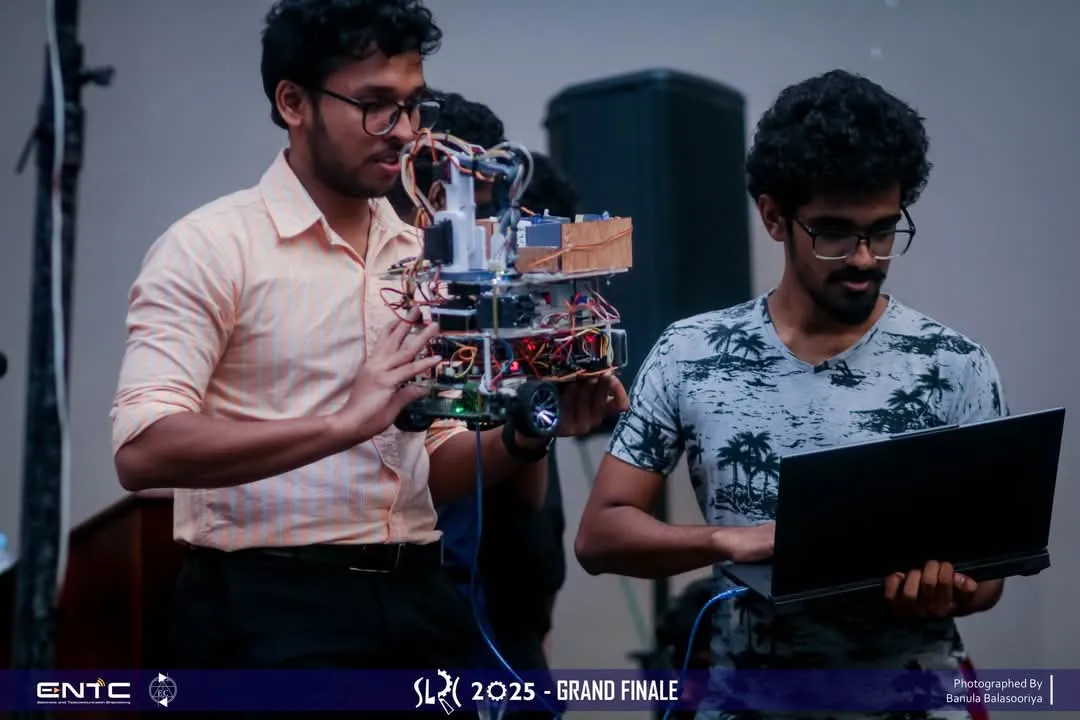
Programming the hidden task, which is only announced on the day.
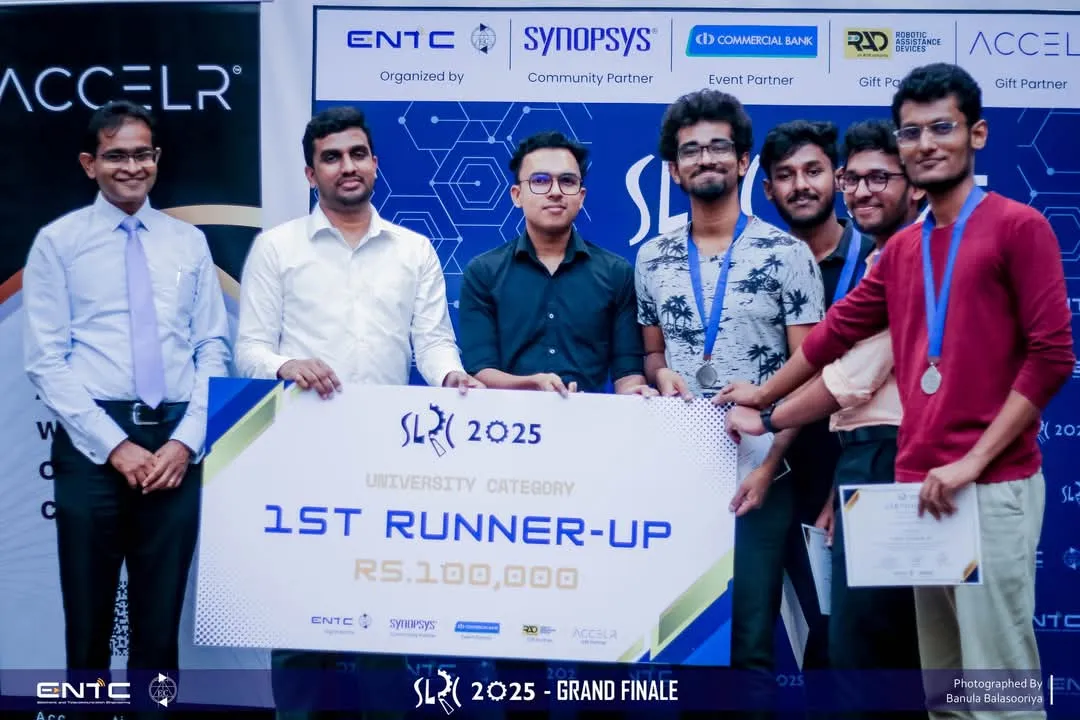
1st runner-up in the university category.